
A door lock is an unlikely object of desire. Latch made a convincing attempt. Its hardware looked considered, its app looked approachable, and its whole presentation suggested that entering a building deserved better than a beige box and a forgotten PIN.
Then came the stock-market debut, the unreliable accounts and the disappearing value. Today, the business calls itself DOOR. The interesting part is how much can change while the company on the paperwork stays the same.
First, it made the lock matter.
Founded in 2014, Latch sold a coherent idea: access for an entire building, with hardware and software designed to work together. Apartments were the centre of the story. A resident’s front door, the lobby and shared spaces could belong to one system. The sales pitch had an obvious audience: developers who wanted their buildings to feel modern. [2]
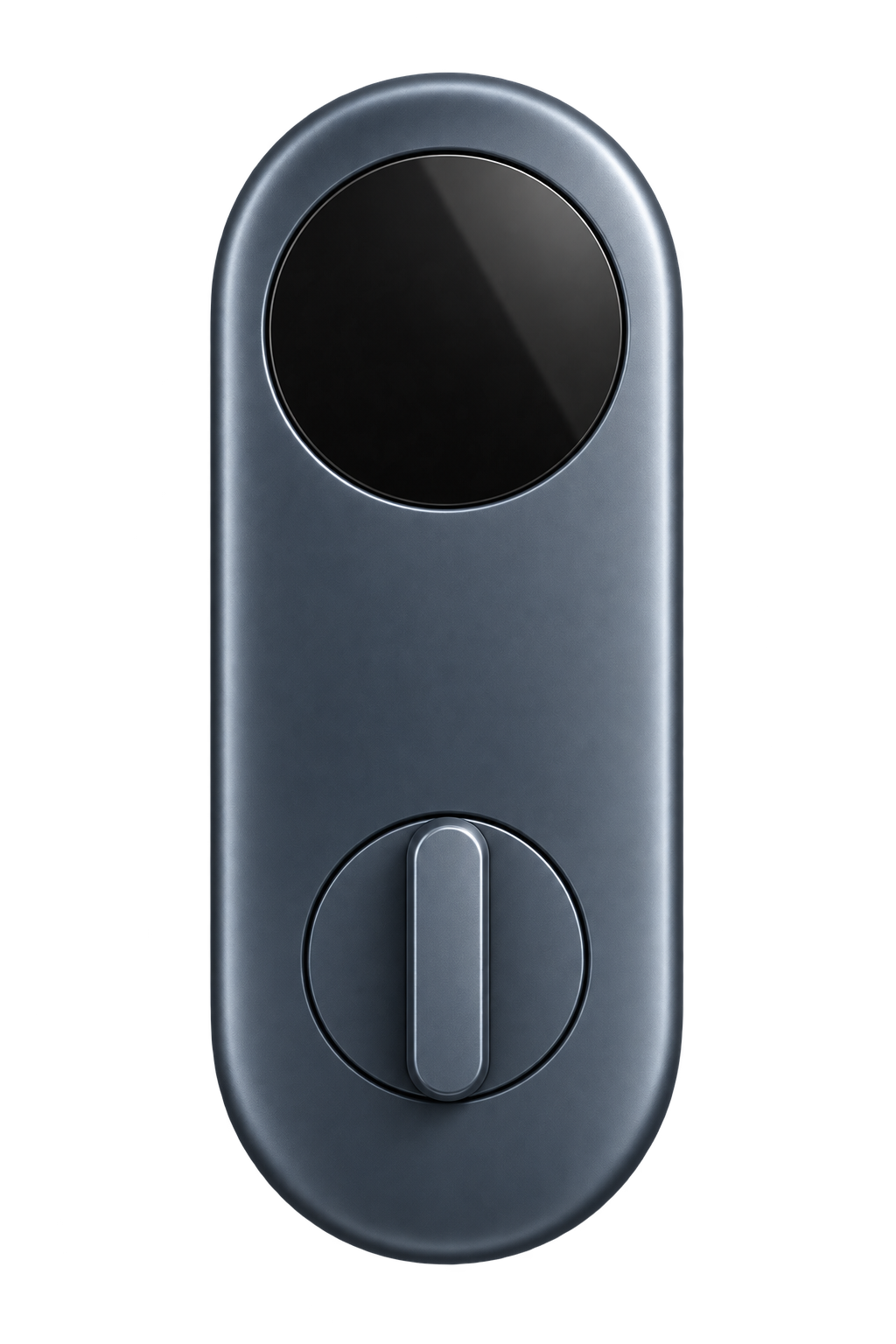
The design was more than a good slide in a fundraising deck. Thomas Meyerhoffer’s Latch C received a 2018 Good Design Award Best in Class distinction in Australia. Its circular face and restrained form made a lock look like a consumer product someone had bothered to design. That was a useful change in an industry seldom accused of vanity. [1]
Look at the early hardware and then at the current DOOR site. The ambition is recognisable: make building technology feel simple, calm and desirable. The presentation had something of Apple about it: quiet surfaces, careful proportions, very little visual noise. [1][13]
Illustration
Design worth looking back at.
Soft curves. Quiet surfaces. A more considered entrance.
A very expensive entrance.
By January 2021, Latch said it had booked more than 300,000 units across over 35 states. It also said one in ten new US multifamily apartments built in 2019 had Latch. Bookings, however, were not the same as recognised revenue. Still, the proposition had travelled well beyond a design studio. [2]
That month, a Tishman Speyer-sponsored SPAC agreed to take Latch public, valuing its equity at $1.56 billion after the deal. A SPAC is a listed shell that takes a business public through a merger. The deal included $190 million in private investment, with funds managed by BlackRock and Fidelity among the investors. [2]
The combination closed on 4 June 2021. Latch’s subsequent registration statement described roughly $453 million in net additional cash from the transaction. The company had sold a future of recurring software income attached to physical doors. Investors had paid generously for the view. [3]
Then the numbers stopped behaving.
In August 2022, Latch disclosed an investigation into how it recorded revenue and other reporting issues. Later that month, it said its 2021 and first-quarter 2022 accounts could no longer be relied upon. Its initial explanation: sales terms had not reached the right people internally. [4]
In plain English, the conditions attached to a sale matter. Shipping a box does not settle whether a customer must pay for it, may return it, or has actually taken control of it. Revenue recognition is where those inconvenient details become numbers. Latch’s internal process had failed to capture relevant terms. [4]
The repair took years. The restatement was completed in December 2024; DOOR says it became current with SEC reporting in February 2026. By then the public-market story had already come apart. [10][14]
The doors stayed. The value didn’t.
Two dated prices give a sense of the damage. Latch reported a $12.96 closing share price on 23 June 2021. The Real Deal reported a $1.68 close on 1 August 2023. That is a fall of about 87% between those observations, not a peak-to-trough calculation or a claim about today’s price. [3][5]
The long way down.
Nasdaq suspended trading on 10 August 2023; its formal delisting announcement followed on 20 March 2024. The shares subsequently traded over the counter as LTCH. Losing an exchange listing did not switch off the locks, or automatically cancel every share. It did leave shareholders with a very different investment from the one celebrated at the listing. [6][12]
The regulator’s version.
On 1 October 2026, the SEC issued a settled cease-and-desist order against Latch. It said annual revenue had been overstated by approximately 107% for 2019, 39% for 2020 and 50% for 2021, measured against the corrected amounts. These were not rounding errors. [7]
The SEC found breaches of anti-fraud rules and financial reporting safeguards. Latch settled without admitting the findings, apart from accepting the SEC’s jurisdiction. The $1 million civil penalty was payable in four instalments. The SEC also acknowledged Latch’s cooperation and efforts to put things right. [7]
The penalty goes to the US Treasury. It was not a refund of the SPAC-era dream. [7]
DOOR presented the settlement as the end of its major legacy matters. It also reported resolutions of four shareholder lawsuits. The last was agreed in principle, which is still a step short of final court approval. [14]
A short history of a long reset
Same company. Different people at the door.
The leadership changed before the branding did. Co-founder Luke Schoenfelder resigned as CEO in January 2023; Jason Keyes became interim CEO. In July, Latch bought Ring founder Jamie Siminoff’s Honest Day’s Work, paying with roughly 29 million shares and $22 million in promissory notes. Issuing shares to acquire a business changes the ownership mix. It does not create a clean break with the existing company. [8][9]
Dave Lillis succeeded Keyes in February 2025. Siminoff’s later advisory arrangement ended in May 2025, according to company filings. Siminoff was part of the attempted reset. By 2026, he was no longer involved. [10][11]
What the new name actually means
- Public parent
- Latch, Inc.The legal issuer continues.
- Operating subsidiary
- DOOR Systems, Inc.Formerly Latch Systems, Inc.; still wholly owned.
- Customer-facing brand
- DOORRebranded in August 2025; broader building platform.
The June 2026 quarterly report makes the continuity clear. The public parent was still Latch, Inc. Its wholly owned operating subsidiary had changed its name from Latch Systems, Inc. to DOOR Systems, Inc. in August 2025. The business adopted the DOOR brand. The rebrand did not create a new public company. The old filing history—and the old shareholders—came with it. [11]
The part worth keeping.
There is still an operating business. For 2025, the company reported $70.1 million in total revenue, including $22.1 million from software. DOOR now presents access control as part of a wider building-management platform. That is a commercial direction, not proof that the turnaround is complete. [12][13]
For anyone choosing guest-access technology, this is the useful tension. Product design matters. So do support, financial reporting and the ability to keep serving a building years after installation. A lock can outlive the pitch that sold it.
Latch helped make access control something worth looking at. Its history gives the industry a reason to look a little further.
Series
Companies That Shaped Keyless Check-In
The companies, products and decisions that changed how keyless access looks, works and gets sold.
- Part 1VingCard: the hotel key learned to forget
- Part 2What happened to Latch? Beautiful locks, broken numbers, and the new DOORYou are reading
- Part 3Onity: the $50 hotel master key
- Part 4SPG Keyless: the future still needed a keycard
- Part 5How Airbnb shaped self check-in — and the dependency behind the door
Written from public filings, company announcements and contemporary reporting. Design comparisons and pull quotes are editorial observations. Facts checked through .
The paper trail
Sources & notes
15 sources
- Good Design Australia · Latch C, 2018 award entry
Design recognition, product appearance and design attribution.
- Latch / TSIA · SPAC announcement, 25 January 2021
Founded in 2014; company-reported bookings and 2019 apartment adoption; $1.56bn post-money equity valuation; $190m private investment.
- Latch · Registration statement, 24 June 2021
4 June 2021 combination; approximately $453m net cash increase; $12.96 closing share price on 23 June 2021.
- Latch · Non-reliance disclosure, 25 August 2022
Investigation disclosed on 10 August; 2021 and Q1 2022 statements requiring restatement; unreported sales arrangements.
- The Real Deal · Nasdaq deadline reporting, 2 August 2023
Secondary reporting of the $1.68 close on Tuesday, 1 August 2023. Historical comparison only; not a current quote or price series.
- Nasdaq · Delisting announcement, 20 March 2024
Nasdaq confirms securities suspended on 10 August 2023 and announces delisting. These are separate events.
- SEC · Settled order against Latch, 1 October 2026
Release 33-11450; revenue overstatements; Securities Act Sections 17(a)(2) and 17(a)(3), anti-fraud provisions, alongside reporting, books-and-records, internal-control and proxy requirements; $1m penalty; settlement without admitting findings except jurisdiction.
- Latch · Leadership changes, 11 January 2023
Schoenfelder resignation and Jason Keyes appointment as interim CEO.
- Latch · Honest Day’s Work acquisition, 3 July 2023
Acquisition of Siminoff’s business for approximately 29m shares and $22m in promissory notes.
- Latch · New leadership team, 6 February 2025
Dave Lillis succeeds Keyes as CEO; financial restatement completed in December 2024.
- Latch · Q2 2026 Form 10-Q, filed 10 August 2026
Legal and subsidiary names; August 2025 rebrand; Siminoff advisory termination; OTC listing; litigation and current operations. Its proposed SEC settlement is superseded by the 1 October order.
- DOOR · 2025 results, 31 March 2026
$70.1m total revenue and $22.1m software revenue for 2025; legal name Latch, Inc.; OTC symbol LTCH.
- DOOR · Current product website
Current access-control and building-intelligence positioning; product continuity. Viewed 4 October 2026.
- DOOR · Response to SEC settlement, 1 October 2026
Company response: current reporting status in February 2026 and four shareholder lawsuit resolutions, the last in principle. Company characterisation, not independent proof that every court approval is final.
- Yahoo Finance · LTCH daily price history, retrieved 4 October 2026
1,338 available daily closes from 7 June 2021 to 2 October 2026, stored locally. The 23 June 2021 ($12.96) and 1 August 2023 ($1.68) observations match the independently cited article benchmarks. Values are closing prices, not adjusted close.