
Tom Otley went to W Hong Kong expecting to try the future. He had the SPG app, a loyalty account and a reservation showing the right dates. What he did not have was the invitation that would turn his phone into a room key. [1]
It never arrived, even after he connected to the lobby Wi-Fi. A receptionist showed him the system on a hotel phone. That phone opened his room. Then she handed him a normal keycard. [1]
Later troubleshooting produced success on a demonstration door, not the promised experience on his own stay. His December 2014 review in Business Traveller captured the awkward distinction: a door could open by phone while the journey designed around it still failed. [1]
That journey was the interesting part. Replacing plastic with a screen made a good demonstration. Removing the compulsory stop between a tired traveller and a ready room was a much larger ambition.
Before Bluetooth, doors listened.
Starwood did not invent the idea of opening a hotel room with a phone. By September 2010, IHG was testing it at a Holiday Inn near Chicago O’Hare and a Holiday Inn Express in downtown Houston. The trial also offered a route past reception. [2]
OpenWays supplied an unusual mechanism: an encrypted acoustic credential. The phone played a sound; a decoder added to the lock interpreted it. Guests could receive their room number and a link to the key by text message. Before the hotel key became an app interaction, one version was something a door listened to. [3]
These were pilots, not evidence that phone keys had conquered hotels. But they make a sweeping 2014 invention claim difficult. The key and the desk-bypass idea were already in circulation. Starwood’s contribution was to put them inside a familiar loyalty app and begin taking that package across several hotel brands.
The important thing moved earlier.
SPG Keyless went live on 5 November 2014 at ten W, Aloft and Element hotels. Starwood’s announcement described a Bluetooth-enabled system developed with ASSA ABLOY. Eligible SPG members booked through Starwood, registered a device and opted in. This was a particular route through a hotel stay, not a new power granted to every smartphone. [4][5]
The conventional arrangement put the handover at reception: arrive, wait, complete the hotel’s checks, collect a card. The proposed mobile journey moved those preparations into the app and could deliver the credential before arrival. ASSA ABLOY’s account describes a Seos mobile identity sent to the phone and a Bluetooth Smart connection at the lock. The phone carried the permission; proximity alone was not permission. [6]
The invitation was not the key, and a reservation was not a ready room. Contemporary explanations tied access to room readiness and told guests whether they could go upstairs or still needed reception. Identity and payment requirements had to be satisfied; putting a key on a screen did not abolish them. [7][5]
Same room. A different arrival.
- 1 / 3
Move the handover.
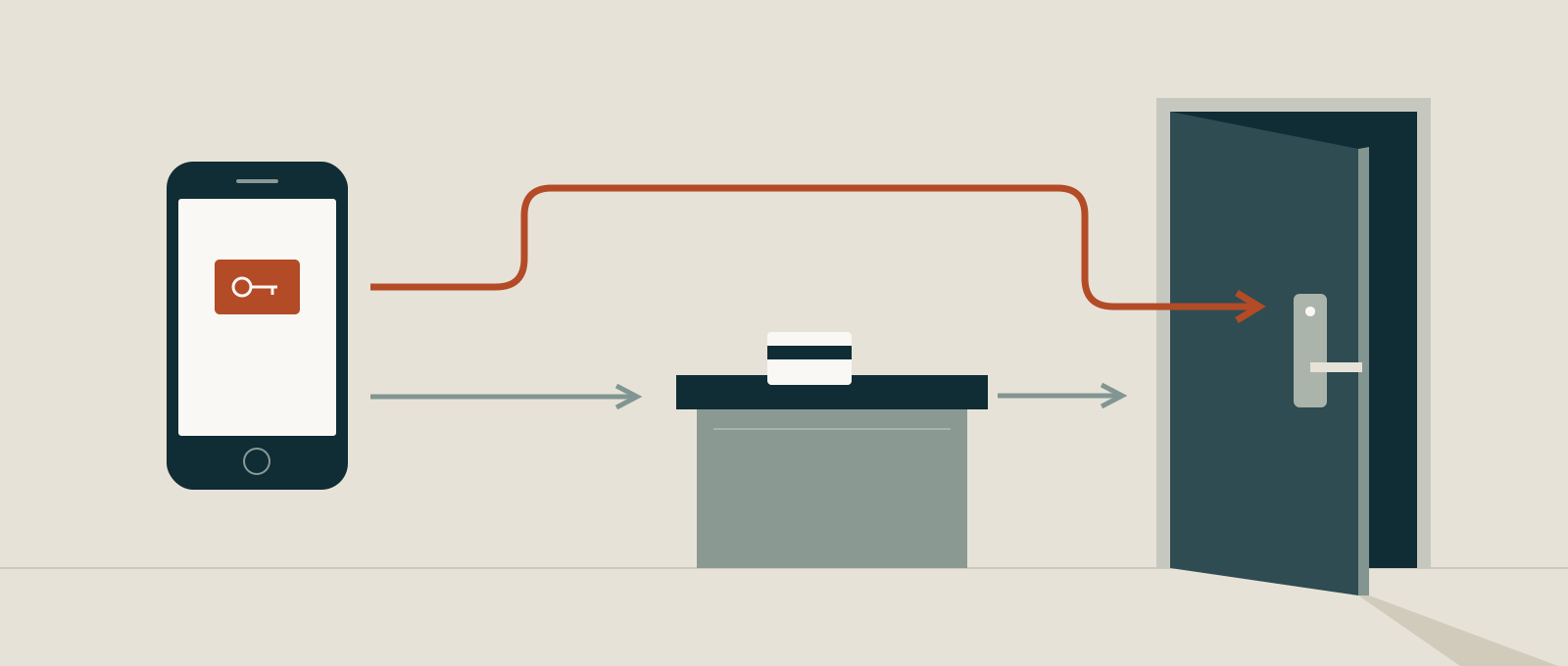
Follow the orange marker. The mobile route can issue the room credential before the guest reaches reception.
Traditional arrival
- Before arrivalBook the room
- At the hotelQueue → checks → collect cardKey issued
- At the doorCard → room
Mobile-key arrival
- Before arrivalBook → digital checks → receive keyKey issued
- At the hotelArrive → pass reception
- At the doorPhone → room
The queue can disappear because the handover happened earlier.
- 2 / 3
The last few centimetres.
Receiving a credential and presenting it to the lock are separate events. SPG Keyless used Bluetooth Low Energy for that final exchange.
Traditional arrival
- Before arrivalReservation confirmed
- At the hotelHotel issues room cardKey issued
- At the doorLock checks card → opens
Mobile-key arrival
- Before arrivalEligible stay → key deliveredKey issued
- At the hotelGuest already has permission
- At the doorApp → Bluetooth → lock checks key
A working lock connection is only the last part of a working arrival.
- 3 / 3
The desk comes back.
If the digital handover fails, the phone has no usable key to present. Staff can resolve the problem or issue a card.
Traditional arrival
- Before arrivalBook the room
- At the hotelComplete checks → collect cardKey issued
- At the doorCard → room
Mobile-key arrival
- Before arrivalInvitation or key missing
- At the hotelStop at reception → get help / cardHandover recovered
- At the doorWorking credential → room
The fallback belongs in the journey too.
“It works” was several different claims.
At W New York–Downtown on launch day, Macworld’s Caitlin McGarry found the demonstration quick and successful when her phone was held flush against the lock. That does not cancel Otley’s experience in Hong Kong. It locates the problem: a successful demonstration and a successful stay were different tests. [5][1]
Starwood’s own engineering account makes the missing work clearer. Writing in 2016, Brennan Gildersleeve described connecting central systems, property systems, the app and new locks, while also handling lifts and other controlled doors. His team had improved opening speed, stability and access when the phone lacked a network connection. A radio link was only one item on the list. [8]
Some faults were smaller, and almost painfully human. CIO Martha Poulter told CIO that an amber lock light during the pilot made guests think access had been refused. Starwood changed it to green. The door had permission. The guest needed reassurance. [7]
This is where a mobile key becomes a hospitality product rather than a clever lock. It must tell a guest what has happened, what to do next and where to get help. Preferably before they have tried the handle three times.
Less transaction. More welcome?
Poulter called the smartphone a “remote control” for the guest’s time at the property. The broader pitch was not that hotels should stop talking to people. It was that staff should no longer need a credit-card transaction as the excuse for their first conversation. [7][9]
That is a more useful promise than an empty reception desk. A guest can want help, a recommendation or a welcome without wanting a queue. Moving the paperwork gives a hotel the chance to separate hospitality from administration. It does not guarantee that the hotel will take it.
There was a commercial bargain too. The service required membership and a direct booking. For Starwood, the convenient route to the room also ran through its own relationship with the guest. The app was both a key holder and a reason to keep booking inside the programme. [4][7]
From demonstration to expectation.
The launch announcement aimed for 150 hotels by the end of 2015. That was a target. In June 2016, Starwood reported availability at more than 160 properties in over 30 countries, covering 36,000 doors. It also reported more than 350,000 registrations. Registrations were not a count of successful stays. [4][9]
The same announcement expanded the offer to selected additional brands and announced support for multiple guests sharing a room. Even the apparently simple matter of giving both occupants a key had become software work. [9]
Starwood helped turn mobile entry from a curious pilot into a recognisable hotel service. It did not invent every part, and its early users did not all glide upstairs. Its useful achievement was to connect the credential to the journey around it.
For keyless check-in, that remains the test. Can the guest receive valid access at the right time, understand it and recover when something fails? A phone opening a demonstration door answers only the smallest of those questions.
The future was not the absence of a plastic card. It was the possibility that, by the time you reached the hotel, the hotel had already finished making you wait.
Series
Companies That Shaped Keyless Check-In
The companies, products and decisions that changed how keyless access looks, works and gets sold.
- Part 1VingCard: the hotel key learned to forget
- Part 2What happened to Latch? Beautiful locks, broken numbers, and the new DOOR
- Part 3Onity: the $50 hotel master key
- Part 4SPG Keyless: the future still needed a keycardYou are reading
- Part 5How Airbnb shaped self check-in — and the dependency behind the door
Based on contemporary first-hand reporting, launch announcements and accounts from the companies building the systems. Individual trials are not reliability statistics; rollout figures are attributed. The workflow is a simplified explanation of eligible stays. Pull quotes are editorial observations. Facts checked through .
The paper trail
Sources & notes
9 sources
- Tom Otley, Business Traveller — Tried and Tested: SPG Keyless technology, 2 December 2014
First-hand W Hong Kong account. The staff phone did open his actual room; his later troubleshooting succeeded only on a demonstration door. The publication date is not treated as the stay date.
- Michael B. Baker, Business Travel News — IHG phone-key trials, 22 September 2010
Contemporary report of active pilots at Holiday Inn Chicago O’Hare Rosemont and Holiday Inn Express Houston Downtown, including reception bypass. This establishes a predecessor, not the first-ever mobile key.
- OpenWays — IHG pilot announcement, 16 June 2010
Vendor description of Crypto Acoustic Credential, decoder retrofit and SMS delivery. Planned August trials are distinguished from September reporting of operation. Universal compatibility and security claims are not independently adopted.
- Starwood / Business Wire — SPG Keyless global launch announcement, November 2014
The syndicated page is stamped 3 November; its body specifies go-live on 5 November, corroborated by Macworld’s launch-day report. Ten opening hotels and the end-2015 target are distinct from later deployment. The corporate “first” claim is not adopted.
- Caitlin McGarry, Macworld — first-hand launch demonstration, 5 November 2014
Successful W New York–Downtown demonstration and app preparation/room-readiness workflow. Its early-2015 rollout forecast differs from the primary announcement’s end-2015 target; neither is used as proof of completed rollout.
- ASSA ABLOY — Annual Report 2014, printed page 18
Primary supplier account of Starwood Mobile Access, Seos Mobile ID, advance credential delivery and Bluetooth Smart. Desk bypass is explicitly conditional. The diagram compresses hotel operations into three phases; it is not an app or protocol specification.
- Lauren Brousell, CIO — interview with Martha Poulter, 3 August 2015
Account/device requirements, room readiness, possible desk referral and the amber-to-green pilot change. The light-change anecdote is Starwood’s account, not an independent usability study.
- Brennan Gildersleeve, Hospitality Upgrade — Opening More Doors SPG Keyless, June 2016
Participant’s engineering retrospective on integration and continuing improvements. Its 165-property figure differs slightly from the June announcement’s more-than-160 formulation; the feature uses the latter and does not infer an exact audited count.
- Starwood / Business Wire — next-generation SPG Keyless, 28 June 2016
Company-reported properties, doors and registrations; announced brand expansion and shared-room keys. Availability is not universal use. Promised future updates are not treated as already installed everywhere.