
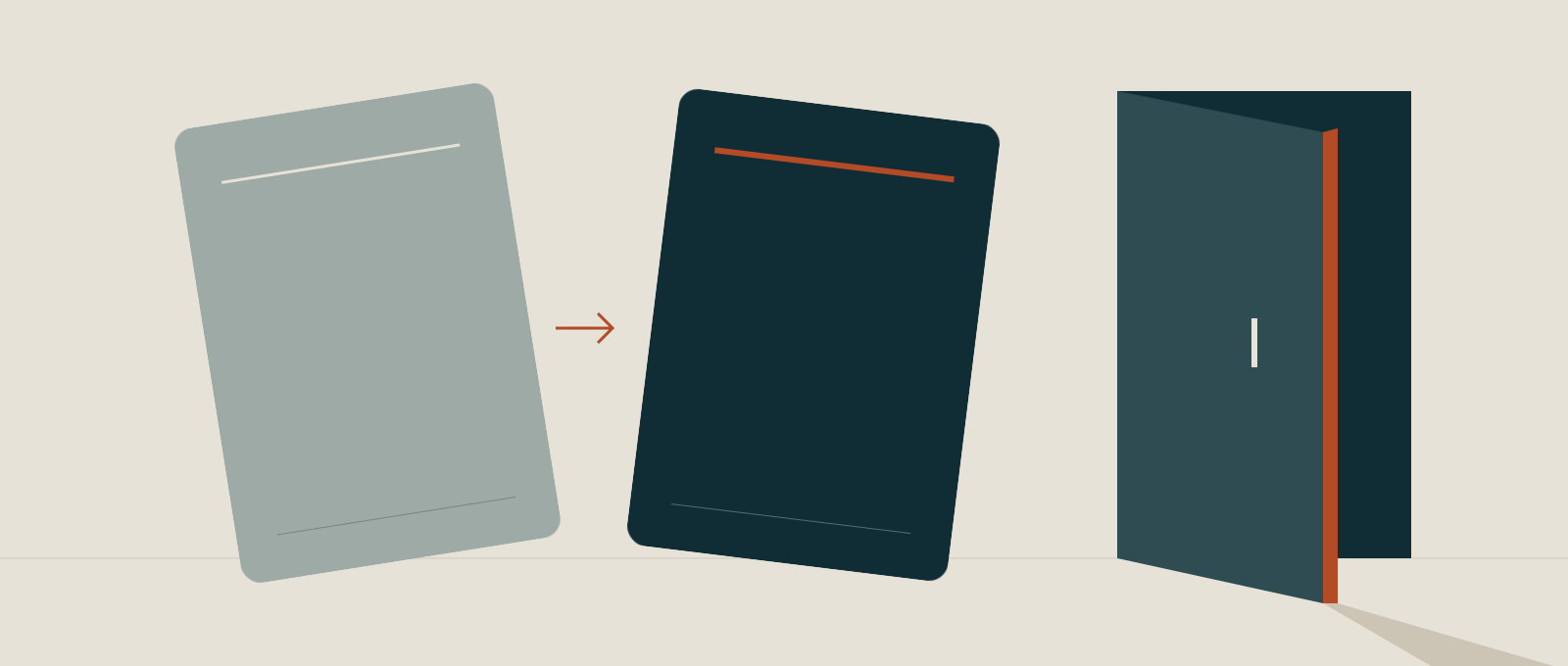
A hotel key could have a longer stay than its guest. Leave it in a coat pocket, take it home, keep it for years: unless someone changed the lock, the metal still knew the door. Checkout was something that happened at reception. The key had not been informed.
That was the problem Tor Sørnes helped make ordinary enough to solve. The Norwegian engineer’s VingCard let a hotel change which card a lock would accept. The guest could keep yesterday’s piece of plastic. Its permission did not have to travel with it. [1]
Before the app, a factory in Moss.
Sørnes worked at a factory in Moss that made locks, fittings and ice skates under the Ving name. He had joined in 1950. [2]
Vingcard says the 1974 attack on singer Connie Francis in a hotel room inspired him to find a safer system. His answer would involve two pieces of punched plastic. [3][1]
Programmable. No software required.
The early system was mechanical. The guest carried a punched key card. A separate code card stayed in the lock. Their patterns complemented one another: a hole on one faced solid material on the other. Together they positioned the blocking pins so the locking member could move. A wrong pattern left it blocked. [1]
Recoding meant physically replacing the lock’s code card. The previous guest card would then fail. There was no checkout clock, radio message or connection to reception doing this automatically. Someone had to change the lock’s instructions. [1]
Same door. New permission.
Hole Solid× Mismatch
-
1 / 4
The old guest can enter.
Card A complements code A. Each position has one hole and one solid surface; the mechanism can release.
Guest card A
In the lock: code A
Door can open
-
2 / 4
Staff change the code.
The code card inside the lock is replaced with code B. This is a physical change at the door.
No guest card inserted
In the lock: code B
Code changed
-
3 / 4
The old card no longer works.
Card A has not changed. The lock has. The marked positions no longer complement each other.
Guest card A
In the lock: code B
Door stays locked
-
4 / 4
The new guest can enter.
Card B complements code B. The door can open for the new guest.
Guest card B
In the lock: code B
Door can open
That distinction matters. A metal lock could also be rekeyed. VingCard made changing the accepted credential a card operation, rather than a new cylinder or a locksmith’s job. The useful invention was less about what the guest held than what the hotel could stop accepting.
A lot of possibility in a little plastic.
The familiar account gives the card 32 possible hole positions. Hole or no hole at each position means 2³² patterns: about 4.3 billion. That is the arithmetic behind the often-repeated “4.2 billion” claim. It describes possible patterns, not a guarantee that a lock cannot be defeated. [2]
Even that tidy number needs a footnote. A later technical patent describes commercial VingCard locks with 32 potential positions but only 30 in use. The celebrated design principle and every lock shipped were not necessarily identical. [5]
The more useful number was one: one lost card no longer had to leave a room tied indefinitely to an absent guest. A vast choice of combinations mattered because hotels needed to keep changing their minds.
Changeable card access predated VingCard. A 1969 US patent described a resettable magnetic mechanism. VingCard’s contribution was the hotel system it built around its own mechanical design. [4][1]
Then it had to work in a hotel.
Norwegian reference works place an installation at Park Hotel in Sandefjord in 1978. Atlanta supplied the more conspicuous test. According to Sørnes’s biography, Peachtree Plaza tried the locks in its upper-floor suites that year, then ordered them for the rest of the hotel six months later. An experiment had become an order for more than a thousand rooms. [6][2]
Later accounts put the Peachtree sale in 1979. A trial followed by a wider order could explain the difference, but the records reviewed here do not settle it. The hotel’s own opening in 1976 is another date again. It should not be mistaken for the lock installation. [7][8]
Hotel scale asks less glamorous questions than a demonstration does. Can staff change the code reliably? Can the system survive repeated use? Can replacements arrive when needed? A thousand doors turn an elegant mechanism into an operating business.
Success had to be assembled.
By 2002, Norwegian engineering magazine Teknisk Ukeblad reported more than three million VingCard locks delivered to hotels, ships and institutions in 137 countries. Its factory report was refreshingly unromantic. Sales had surged during the 1990s; production had struggled to keep up. Assembly was still manual. Improving the flow of parts mattered as much as having invented the lock. [9]
VingCard joined ASSA ABLOY in 1994. Today the Vingcard name is again the group’s main hospitality brand, following its return in 2024. The corporate labels have moved around almost as much as the credentials. [10]
The product history is less neat than a row of invention dates. Vingcard’s own legacy table lists Original electronic-lock models in the early 1980s and Classic Mag in 1992. The Norwegian biographies date the magnetic-stripe system to 1992–93. Treating that as the beginning of all electronic VingCard locks would erase the earlier models. [11][6]
Magnetic stripes made the code writable. RFID made the exchange contactless. Phones added a way to deliver the credential without handing over a card. These technologies overlapped; hotels did not all change locks on the same Tuesday. Vingcard still documents upgrades from magnetic-stripe hardware to RFID and mobile access, subject to compatibility. [12]
The key disappeared into something else.
There is a revealing detail in Starwood’s 2014 mobile-key announcement. Its earlier Smart Check-In programme had already let guests skip traditional check-in using an RFID card in 2011. The plastic had not prevented a keyless arrival. [13]
The 2014 system, developed with ASSA ABLOY, used Bluetooth and the SPG app. The initial rollout covered ten hotels. Eligible guests could receive their room number and key on the phone, then bypass reception where the service was available. Access was becoming part of the arrival workflow, rather than just something handed over at its end. [13]
In December 2021, Hyatt introduced room keys in Apple Wallet at six US hotels, using ASSA ABLOY’s Vostio system. With Express Mode, a guest could hold an iPhone or Apple Watch to the reader without opening an app. The key had moved again, this time into a place the phone already used for other credentials. [14][15]
A room is borrowed. So is access.
Apple’s current hotel-key instructions say the credential is remotely deactivated when the stay ends. That is a long way from changing a card inside a mechanical lock. It also depends on a participating hotel and compatible equipment. Putting a key in a wallet does not modernise every door behind it. [16]
Today’s electronic systems are not Sørnes’s mechanism with a screen attached. Their credentials, readers and security are different. What survives is the operating idea: the hotel decides which permission is valid, and that decision can change without replacing the door hardware.
So one useful way to trace keyless check-in is to start before the key disappeared. Start when it became practical to tell the lock that a guest’s permission was over. VingCard helped make that an everyday hotel operation.
The guest leaves. The door moves on.
Series
Companies That Shaped Keyless Check-In
The companies, products and decisions that changed how keyless access looks, works and gets sold.
- Part 1VingCard: the hotel key learned to forgetYou are reading
- Part 2What happened to Latch? Beautiful locks, broken numbers, and the new DOOR
- Part 3Onity: the $50 hotel master key
- Part 4SPG Keyless: the future still needed a keycard
- Part 5How Airbnb shaped self check-in — and the dependency behind the door
Based on patents, Norwegian reference works, contemporary reporting and attributed company records. The illustrations explain principles rather than reproduce a particular lock. Pull quotes are editorial observations. Facts checked through .
The paper trail
Sources & notes
16 sources
- Tor Sørnes — US4149394A, mechanical code-card lock
Primary mechanism and filing record. Norwegian priority 6 April 1977; US grant 17 April 1979. Describes physical code-card replacement, not timed checkout expiry.
- Fredrik Th. Bolin — Tor Sørnes, Norsk biografisk leksikon
Dates the punched-card proposal to 1975 and the first completed system to 1977. These are distinct from the mechanical-lock patent’s priority and grant dates. Based partly on information from Sørnes in 2004; the account predates the website’s latest update. Source for the Atlanta trial; exact order records were not located.
- Vingcard — its account of the Connie Francis origin story
Company account published in 2025. Cited as the company’s explanation of motivation, not independent verification of what inspired Sørnes.
- US3444711A — an earlier changeable magnetic-card mechanism
Granted in 1969. Establishes prior work on resettable card-operated mechanisms; this article does not claim VingCard invented all programmable access.
- US5355701A — description of commercial VingCard mechanisms
Later technical record, granted in 1994. Distinguishes the original patent from commercial implementations and records 30 used positions within a 32-position matrix. Used for historical description, not a security guarantee.
- Store norske leksikon — Tor Sørnes
Norwegian reference work, updated March 2025. Supports the 1978 hotel deployments and dates the magnetic-stripe development to 1992–93; the manufacturer’s model table adds earlier electronic models.
- Business Excellence — VingCard Elsafe, February 2013
A promotional industry profile by Will Daynes. Gives 1976 for invention and 1979 for the Peachtree sale, differing from the Norwegian biography. A trial/order distinction is plausible, not established.
- Portman Holdings — Westin Peachtree Plaza
The developer’s project record dates the hotel to 1976. That date does not establish when VingCard was installed.
- Hugo Ryvik — Mer luft under vingene, Teknisk Ukeblad
Contemporary reporting, 7 August 2002, on the Moss factory, production changes and reported installed scale. Its broad description of electronic production since 1979 is not used to date the first electronic model.
- Vingcard — Our story
Company chronology for the 1994 ASSA ABLOY acquisition and the 2024 return of Vingcard as the primary hospitality brand.
- Vingcard — Electronic Locks product support lifecycle (PDF)
Manufacturer’s legacy table, especially page 6. Lists Original 1070/1080/1090 in the early 1980s and Classic Mag in 1992. Model dates are not universal dates for adoption across hotels.
- Vingcard — upgrading magnetic-stripe locks to RFID and mobile access
Current manufacturer documentation. Upgrade routes and Bluetooth/NFC support depend on the lock and reader configuration.
- Starwood — SPG Keyless launch announcement, November 2014
Starwood/Business Wire release republished by Franchising.com. Documents ten initial hotels, ASSA ABLOY collaboration and the earlier 2011 RFID programme. Its conflicting day-level datelines are avoided; planned expansion is not counted as deployed.
- Hyatt — room keys in Apple Wallet, 8 December 2021
Operator’s launch announcement: six participating US properties and Express Mode. A limited rollout, not availability at every Hyatt hotel.
- ASSA ABLOY — Hyatt selects Vostio with Apple Wallet room keys
Company announcement republished by Hotel Tech Report in December 2021, connecting the Hyatt rollout to Vostio. Treated as supplier reporting.
- Apple Support — add a hotel room key to Apple Wallet
Current requirements and end-of-stay deactivation. Does not establish the timing of revocation at every offline reader or imply universal hotel support.