
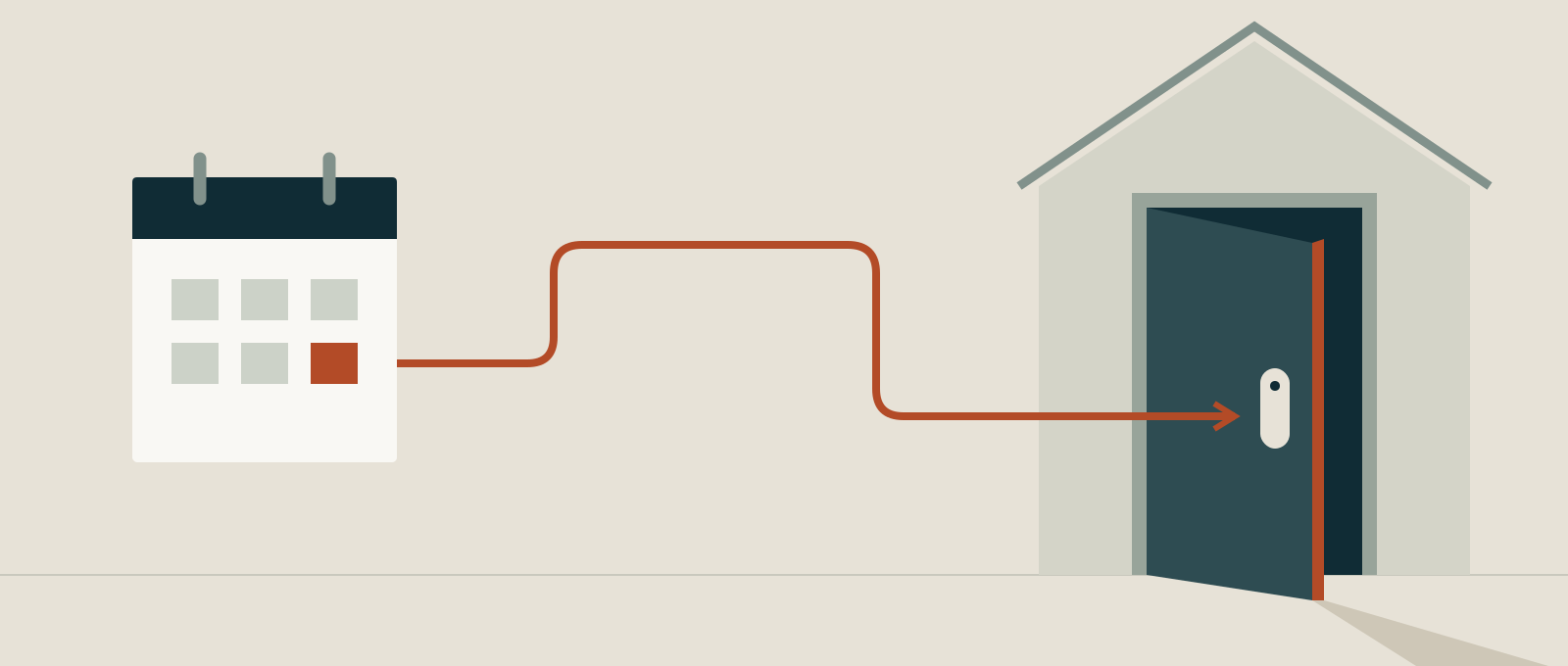
It is difficult to overstate Airbnb’s influence on self check-in and vacation-rental access.
Airbnb’s latest published facts, updated in May 2026, report 9M+ active listings, 5.5M+ hosts and 2.5B+ guest arrivals, with listings across 220+ countries and regions. The arrivals are an all-time total. [1]
Those are not nine million smart locks. They are the reach of a platform where even a small product, data or integration decision can affect millions of hosts and guests—and the companies building tools around them.
Airbnb did not invent smart locks or self check-in. It helped make unattended arrival normal and created a huge market for technology that turns bookings into access. The host no longer had to spend Friday evening watching an arrival time slip further into Saturday.
There was a catch. The more a property organised itself around Airbnb, the easier it became to confuse the place that supplied the booking with the system that should control the door. A sales channel should be useful. It should also be replaceable.
The host did not have to be home.
Hotels already had ways to receive people late at night. A private apartment usually lacked the staffing budget. For a host, handing over a key meant coordinating two journeys, often across delayed flights, uncertain phone connections and a language barrier.
A lockbox was an uncomplicated answer. A keypad or smart lock could go further, giving each stay its own access without passing a physical key around. Self check-in did not always mean keyless. The important change was that the guest and host no longer had to arrive together.
Airbnb helped turn that practical workaround into a recognisable service. In June 2017, its app gained reusable check-in guides: hosts could explain the right entrance, the lockbox and the code once, and guests could consult the instructions offline. The app was beginning to do a small part of reception’s job. [2]
It was a modest feature with a larger consequence. A host’s local knowledge could become a repeatable arrival. The awkward explanation about the second gate no longer had to begin afresh with every guest.
A booking became an instruction.
Suppliers had already seen the opportunity. In November 2015, RemoteLock joined Airbnb’s new Host Assist programme with a straightforward proposition: connect the listing, turn reservation details into a code and make that code valid for the stay. Airbnb brought the booking. A partner arranged access. [3]
By 2018, August described automatically issuing keypad codes or app access, then adjusting permission when an Airbnb reservation changed. A cancellation, a later departure or a new guest could become a software event rather than another task on the host’s list. [4]
Around that idea sat several kinds of business: lock manufacturers, access services, property management systems and messaging tools. Some used partner integrations. Others read exported iCal calendars and extracted details from the booking feed. The connections differed, but the attraction was the same: make one reservation set the rest in motion. [5][6][7]
This is how a marketplace can shape hardware without manufacturing it. Once hosts want the lock to understand a reservation, a keypad is no longer judged only by its finish or its battery life. What it connects to becomes part of what it is worth.
A small break exposed the bigger bargain.
Airbnb’s iCal export was a calendar feed that some tools also used to arrange door access. In 2019, Airbnb decided to restrict it for privacy reasons. Its notice, effective 1 December, removed guest names and reservation codes from event titles and limited phone numbers to their last four digits. Automations built around the old fields had to change. [9][10]
An earlier disruption had already shown why those details mattered. In April, guest names and phone numbers disappeared from some feeds. Stay dates still arrived; information the lock software needed did not. The booking-to-access chain broke for affected hosts. Contemporary reports described a temporary bug, and one host later reported the data returning. [5]
During the April disruption, a host posting as Derek193 reported that his door codes had been deleted and his guests locked out at 2:30 a.m. He wanted the missing names and phone numbers restored. Another host, David_Bergmann, had to create lock users manually while his integration was down. [8][5]
A calendar could still show an occupied night while the automation that arranged entry stopped working. Airbnb controlled what the feed supplied. The host’s software depended on it. The guest met the consequence at the door.
From finding the property to opening it.
The larger story continued well beyond a broken feed. Airbnb kept bringing more of the arrival into its own product. Its 2023 Winter Release put arrival-guide editing alongside the listing itself and announced native smart-lock integration. By August 2024, the US and Canada rollout covered compatible Schlage, August and Yale models. [11][12]
The direction matters more than the brand list. First, Airbnb connected guests and hosts. Then it helped explain the arrival and encouraged partners to automate it. Now, for eligible properties, it could coordinate the guest credential inside the same service that sold the stay.
Guest expectations were moving too. Airbnb says self check-in ranked among its ten most-searched amenities worldwide in 2025. The feature had become something to seek out before booking, rather than merely an arrangement to negotiate afterwards. [13]
The convenience can be substantial: fewer handovers, less copying, clearer instructions. But a smoother interface does not remove the question of control. With Airbnb-managed guest codes, for example, a manual edit in the lock app is reversed at the next sync. The integration is doing its job. It also makes clear which system is in charge. [14]
The booking moved closer to the door.
- 1 / 4
The host makes the connection.
The platform supplies a reservation. The host arranges the key handover or sends entry instructions.
Behind the arrival
- BookingAirbnb reservation
- Access managementHost arranges arrivalHost coordinates
- Guest credentialKey / instructions → guest
The same front doorGuest arrives → entryThe booking is digital. The coordination still belongs to the host.
- 2 / 4
A market for automation.
Partners and software tools connect booking information to the lock. A stay can produce temporary access without another handover.
Behind the arrival
- BookingAirbnb reservation
- Access managementPartner / automation → lock servicePartner coordinates
- Guest credentialTemporary code → guest
The same front doorValid code → entryThe reservation becomes an instruction other companies build around.
- 3 / 4
The platform runs the handover.
Airbnb’s direct integration manages guest codes for compatible locks and eligible listings. More of the arrival now sits inside the booking platform.
Behind the arrival
- BookingAirbnb reservation
- Access managementAirbnb integration → lock serviceAirbnb coordinates
- Guest credentialStay-limited code → guest
The same front doorValid code → entryThe interface gets simpler. Operational dependence gets deeper.
- 4 / 4
Keep the channel replaceable.
A supported PMS or access service can organise arrivals from several channels and direct bookings. Choose it for control, recovery and the ability to switch.
Behind the arrival
- BookingAirbnb / Vrbo / Booking.com / direct
- Access managementPMS / access service → lockOperator chooses the system
- Guest credentialTemporary credential → guest
The same front doorSame door → entryA different booking source should not require a different front door.
The next guest may book somewhere else.
For operators, the future should not be a choice between automation and independence. It should be automation that survives a change of booking channel. A direct guest needs the same reliable arrival as somebody from Airbnb, Booking.com or Vrbo.
A separate property management system can help organise that. Airbnb itself supports a PMS route: the PMS manages codes and Airbnb displays them to its guests. That is a useful boundary. The channel can carry the instructions without being the place where the whole access operation lives. [16]
A PMS is still a supplier, with its own connections and limits. Buying another subscription is not the same as gaining independence. What matters is whether the operator can manage access across channels, recover when a connection fails and change providers without abandoning tomorrow’s arrivals. [7]
Don’t lock yourself out.
Airbnb’s lasting contribution to keyless check-in is bigger than a particular lock integration. It helped make a once-informal handover into a product, an expectation and a market for other businesses. It continues to shape the industry by deciding which parts of that journey belong inside its app.
If your property has no independent way to issue access, this can happen again. Airbnb—or another large booking platform—can change a feed, API or integration and interrupt code creation or delivery. The guest’s booking may still be valid. That does not help much outside a locked door.
The lesson for a host is to separate distribution from the ability to run the property. Use the platform to find guests. Use its conveniences where they fit. But know how to issue access for a direct booking, keep usable entry instructions outside one app and maintain a recovery route that does not depend on the same connection that failed.
Airbnb opened the door. Just make sure you still own the keys.
Series
Companies That Shaped Keyless Check-In
The companies, products and decisions that changed how keyless access looks, works and gets sold.
- Part 1VingCard: the hotel key learned to forget
- Part 2What happened to Latch? Beautiful locks, broken numbers, and the new DOOR
- Part 3Onity: the $50 hotel master key
- Part 4SPG Keyless: the future still needed a keycard
- Part 5How Airbnb shaped self check-in — and the dependency behind the doorYou are reading
Airbnb’s industry influence is an editorial interpretation of documented products, partnerships and scale, not a measured ranking against competitors. Company figures are attributed. Host incident reports are anecdotes, not audited findings; April 2019 reports are distinct from the later December privacy change. Current integrations were checked on 4 October 2026. The final architecture is a recommendation, not a prediction. Pull quotes are editorial observations. Facts checked through .
The paper trail
Sources & notes
17 sources
- Airbnb — company facts, updated May 2026
Company-reported figures: 9M+ active listings, 5.5M+ hosts, 2.5B+ all-time guest arrivals and listings in 220+ countries and regions. Global facts panel last updated May 2026; checked 4 October 2026. This supersedes the older February UK panel previously cited here. Arrivals are cumulative, not unique guests or an annual figure. These totals do not measure self-check-in adoption or installed smart locks.
- Deanna Ting, Skift — in-app check-in guides, 9 June 2017
Contemporary reporting on reusable host instructions, entrance/lockbox/code details and offline access. The original Airbnb blog URL was unavailable; the accessible reporting is the evidence used.
- RemoteLock / LockState — Host Assist announcement, 12 November 2015
Vendor announcement of Airbnb Host Assist participation and reservation-based, time-limited access. This partner route is not assumed to have used the public iCal feed.
- August — Airbnb guest-access automation, 25 June 2018
Primary description of keypad/app access and reservation changes, predating the later native Airbnb integration.
- Airhosts Forum — iCal export disruption, 20–21 April 2019
Contemporaneous host reports. David_Bergmann described RBoy/SmartThings integration trouble and manually creating users. Forum explanations of motive, legality or platform-wide impact are not adopted as facts.
- OwnerRez — channel API integrations
Example of a PMS connecting several booking channels. Supported fields and functions vary; inclusion is architectural evidence, not a product recommendation.
- OwnerRez — door-lock integrations
Separates reservation handling, provider/PMS code generation and guest messaging. Capabilities, cancellation and revocation depend on the lock connection; not a guarantee that every channel or device behaves identically.
- Derek193 — Airbnb Community Center, 21 April 2019
Public display name. Reported a 2:30 a.m. lockout and deleted door codes while asking for iCal names and phone numbers to return. Verified in the rendered thread; an individual report, not independently audited logs or proof of the exact deletion mechanism.
- Airbnb Community Center — reproduced calendar-change notice, 28 November 2019
Zappa0 reproduced an Airbnb notice effective 1 December: reduced guest information, Reserved titles, reservation link and last four phone digits. This later announced change is kept separate from April’s incident reports.
- Booking Automation — update dated 30 October 2019
Contemporaneous vendor changelog corroborating Airbnb’s announced 1 December calendar-data restriction and recommending the approved integration.
- Airbnb — Winter Release, 8 November 2023
Arrival-guide editing in the Listings tab and an announced smart-lock rollout. Planned availability is distinguished from the August 2024 expansion. The modern About Airbnb boilerplate is not treated as a 2023 statistic.
- Airbnb — expanded smart-lock integrations, 21 August 2024
August and Yale added after Schlage. The announcement’s eligible US/Canada rollout is not treated as global or compatible with every model; company satisfaction claims are not adopted.
- Airbnb — self check-in guidance and 2025 search data
Updated 31 August 2026. Top-ten amenity claim uses Airbnb’s worldwide searches during 2025; not adoption or causal evidence. Self check-in can include a physical key in a lockbox.
- Airbnb Help — managing guest smart-lock codes
Documents sync states, reversal of manual edits to Airbnb-managed guest codes and regeneration after deletion. These rules are not a claim that Airbnb manages every existing code on a connected lock.
- Airbnb Help — connecting a smart lock
Current direct-integration eligibility, supported models and code lifecycle, checked 4 October 2026. Also points to the alternative supported PMS route.
- Airbnb Help — direct versus PMS-managed locks
The PMS route retains code management in the PMS while Airbnb displays codes. Airbnb lacks real-time lock status in that arrangement. Operational control is distinguished from legal ownership.
- Airbnb Help — backup codes and offline access
Previously synced stay codes can work offline. Backup codes and a separate entry method solve different failures; backup-code removal needs connectivity. PMS handling can differ.